Pool water treatment in Morocco
Under the Moroccan sun a pool is not treated the way it is elsewhere. Chlorine breaks down within hours without a stabiliser, fill water is often hard, and evaporation concentrates everything left in the pool. Good treatment is not about the product: it is about control.
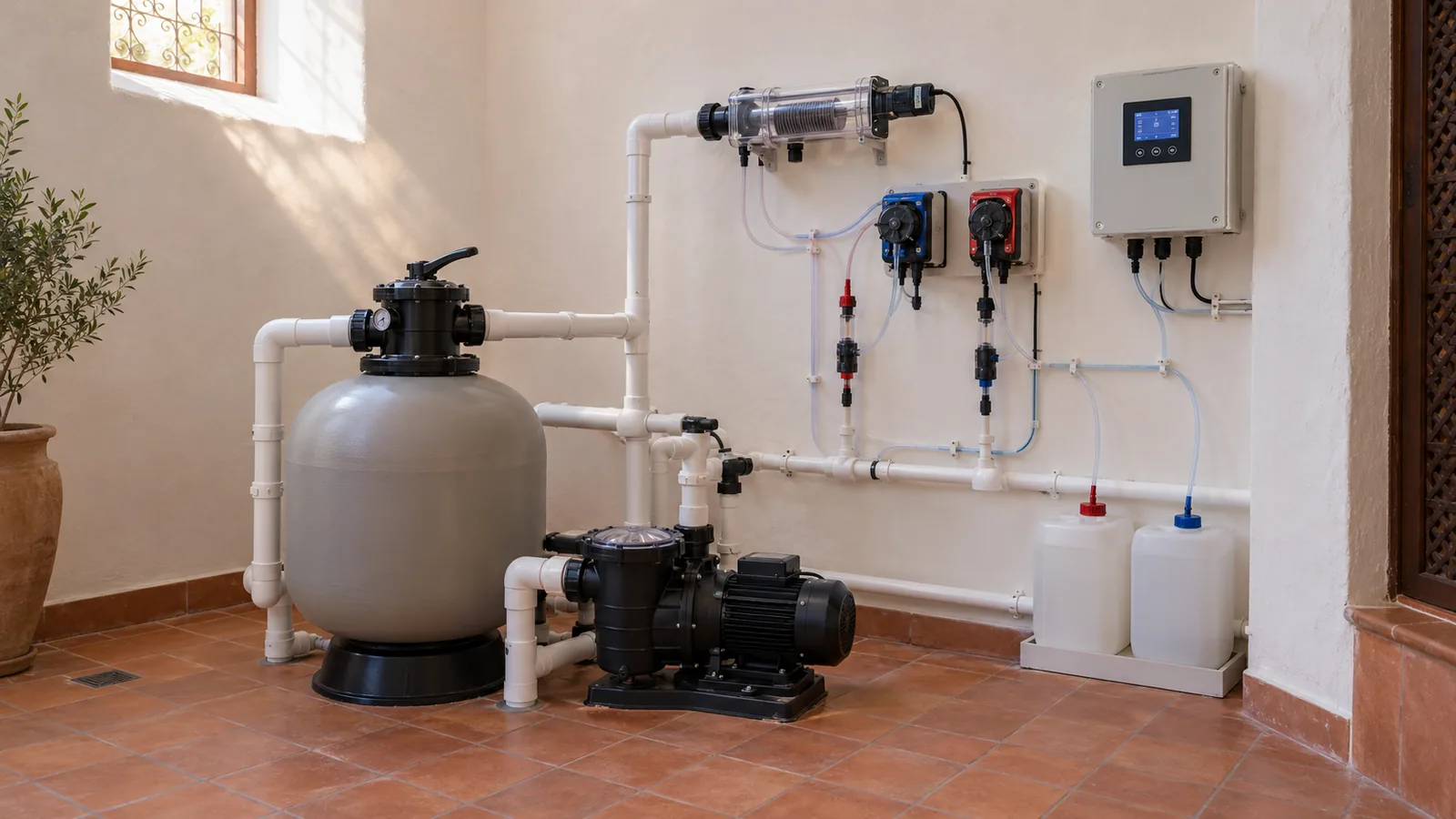
Salt electrolysis
An electrolytic cell turns salt dissolved in the water into chlorine, right inside the circuit. The chlorine produced is the same as the chlorine from a tablet: hypochlorous acid. What changes is that you no longer store chlorine products, no longer handle them, and no longer depend on a delivery.
- Continuous production, dosed to actual demand
- No more drums or tablets stored in the plant room
- Reverse-polarity cell, against scaling
- The salt stays in the water: it is not consumed, only recycled
Electrolysis does not remove chlorine, it produces it on site. The difference lies in handling and consistency, not in the nature of the disinfectant.
pH and chlorine control
A probe measures, a doser corrects, continuously. This is the part most often neglected and the part that makes the most difference: a pH that drifts makes chlorine ineffective, even when there is plenty of it in the water.
- pH probe and automatic correction
- Redox measurement to drive disinfection
- Proportional correction, not all-or-nothing
- Alarms on drift or when a product runs out
What the Moroccan climate changes
Two effects compound. Sunlight destroys free chlorine within hours unless a stabiliser protects it, and evaporation concentrates minerals: the water that leaves is pure, the limescale stays. Top-up water adds more. An uncovered pool therefore drifts continuously towards scaling.
- A stabiliser is essential, but must be watched: above a certain level it blocks chlorine's action
- Calcium hardness of the fill water needs close monitoring
- A roller shutter cuts evaporation and UV exposure, and with it chemical consumption
- A busy pool needs tighter monitoring than a private one
The right pool water parameters in Morocco
Healthy water comes down to a handful of values kept within a range. These are the values we measure during an audit and that the control system must hold all year round. The figures below are the usual benchmarks for a private pool; a shared pool follows its operator's requirements.
- pH
- 7.2 to 7.4
- Above 7.6, chlorine loses most of its effectiveness and limescale precipitates. Moroccan fill water often pushes the pH upwards.
- Free chlorine
- 1 to 3 mg/L
- The share of chlorine actually available to disinfect. Measure it in the morning, before the sun has consumed it.
- Stabiliser (cyanuric acid)
- 30 to 50 mg/L
- Protects chlorine from UV. Above 75 mg/L it blocks disinfection, and it can only be lowered by replacing water.
- Alkalinity (TA)
- 80 to 120 mg/L
- The buffer that stops the pH from jumping around. Adjust it before the pH, never after.
- Calcium hardness
- 150 to 250 mg/L
- Too high and it scales the cell, the filter and the copings. Evaporation pushes it up continuously.
- Salt (salt-water pool)
- 3 to 5 g/L depending on the chlorinator
- About ten times less than sea water: barely noticeable to the taste, with no effect on the skin.
Salt electrolysis or conventional chlorine: which to choose?
Both disinfect with the same chlorine. The difference lies in consistency, handling and cost over time.
| Chlorine tablets or liquid | Controlled salt electrolysis | |
|---|---|---|
| Dosing | Manual, in bursts, depends on whoever comes by | Continuous, driven by a probe |
| Products to store | Drums and tablets to transport and handle | Bags of salt a few times a year |
| Water stability | Chlorine peaks and troughs, drifting pH | Values held within range |
| Bathing comfort | Smell and irritation when dosing is off | Soft water, few chloramines |
| Investment | Low to start, products to rebuy endlessly | Higher to start, reduced consumables |
| Maintenance | Frequent manual checks | Cell cleaning, probes to calibrate |
For a second home, a hotel or any pool nobody checks every day, controlled electrolysis is almost always the right choice. For a small pool closely followed by its owner, a well-run conventional treatment remains defensible.
Hotel and residence pools
On a shared pool, bather load and top-up volume change everything. We measure before we propose: an on-site audit gives the real state of the water and the installation, and everything else follows from there.
Frequently asked questions about water treatment
Is a salt-water pool a chlorine-free pool?
No. The chlorinator makes chlorine from salt, right inside the pipework. The water therefore does contain chlorine, but at a low, stable level and with nothing to pour in. That is why it feels gentler on skin and eyes: there are none of the chloramines that irregular dosing produces.
How much salt does a salt-water pool need?
Usually between 3 and 5 grams per litre, depending on the chlorinator model. Sea water holds about 35 g/L, so a salt pool is nearly ten times less salty. Salt is not consumed; you only top it up to replace water lost to backwashing or overflow.
Does salt water damage the liner, copings or pump?
At 4 g/L the water remains very mildly corrosive. Recent pool equipment is designed for salt. The points to watch are metal parts not rated for it (some lights, cheap ladders) and porous natural stone copings, which simply need rinsing with fresh water. We check these during the audit before proposing electrolysis.
Do I still need stabiliser with a chlorinator?
Yes, in Morocco it is essential. Without stabiliser the sun destroys the chlorine produced within hours and the cell runs for nothing. The right range is 30 to 50 mg/L. Take care not to exceed 75 mg/L: conventional chlorine tablets contain stabiliser, and the level climbs fast if you combine the two.
Why is my water green or cloudy when there is chlorine in it?
Nine times out of ten the pH is too high or the stabiliser too high: the chlorine is present but inactive. The rest of the time it is insufficient filtration (run time or a clogged filter). Measure pH, free chlorine and stabiliser before adding anything: more chlorine at a pH of 8 achieves nothing.
How long does an electrolysis cell last?
Several seasons, provided it does not scale up. Moroccan limescale is its main enemy: a reverse-polarity cell and controlled hardness extend its life considerably. A cell producing less chlorine than before is the first sign of wear.
Can salt electrolysis be fitted to an existing pool?
Yes, in the vast majority of cases. The cell is mounted on the return line after the filter and the control box goes in the plant room. You need a power supply and a little room on the pipework. A pH controller is added at the same time.
How much does a salt chlorinator cost in Morocco?
It depends on the pool volume, the control wanted (pH only, or pH and redox) and the state of the existing installation. We do not quote without seeing the pool: an on-site audit lets us size it right, without oversizing.
What maintenance does a salt-water pool need?
Less than a conventionally chlorinated pool, but not zero: a pH and chlorine check once a week, cell cleaning if it scales, probe calibration at the start of the season, and a check of salt and stabiliser levels a few times a year.
Read also
Water giving you trouble?
Tell us the situation: type of pool, current treatment, what you are seeing. We will come back with a proposal.